The Government Inspector
Writer: Nikolai Gogol
Production: University of The Arts London
Director: Philip Winter
Actor: Mark Anstee
Costume Designer: Philip Winter
The Patterns for Preformance Award, 2025 Competition
Hosted by The Costume Society
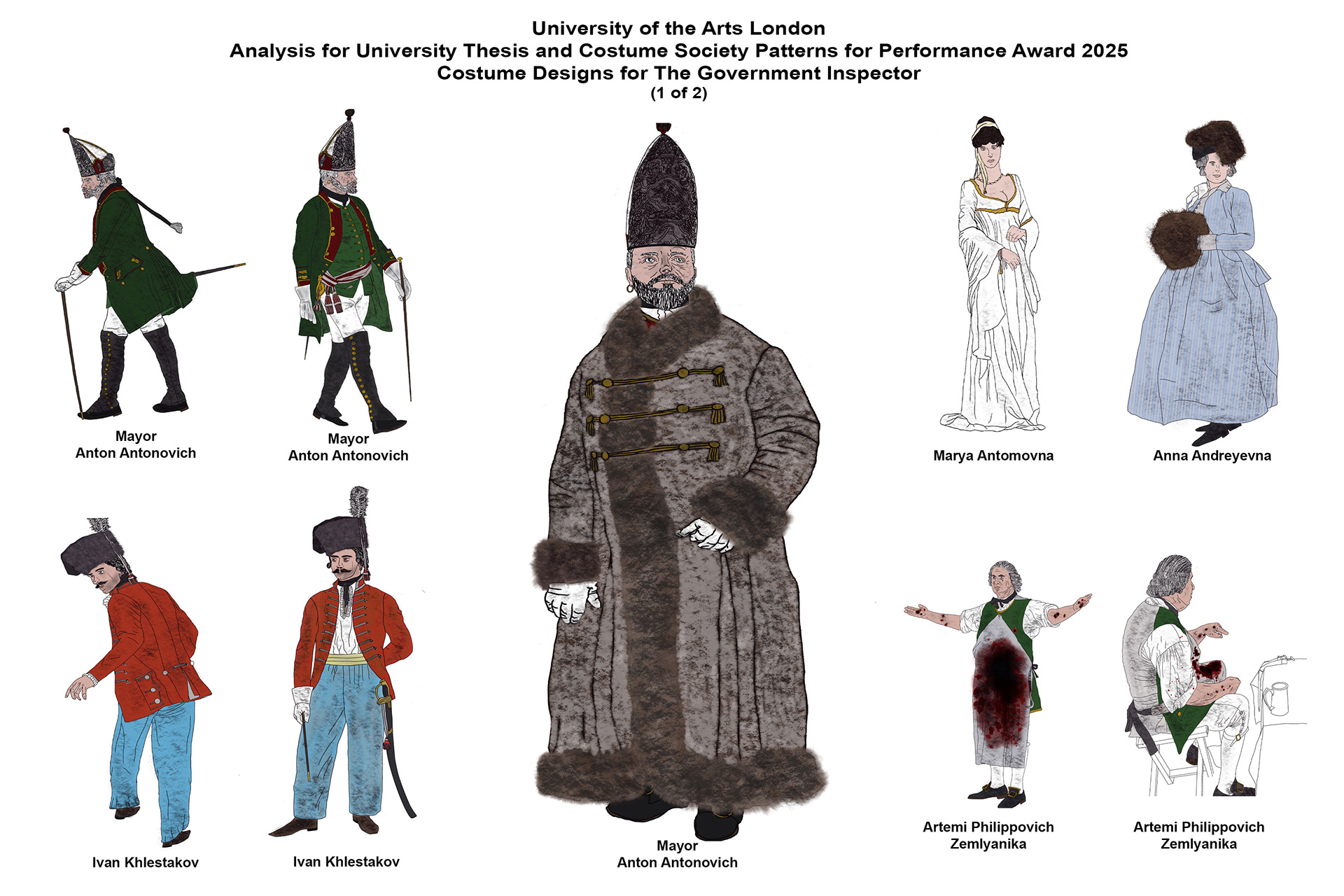
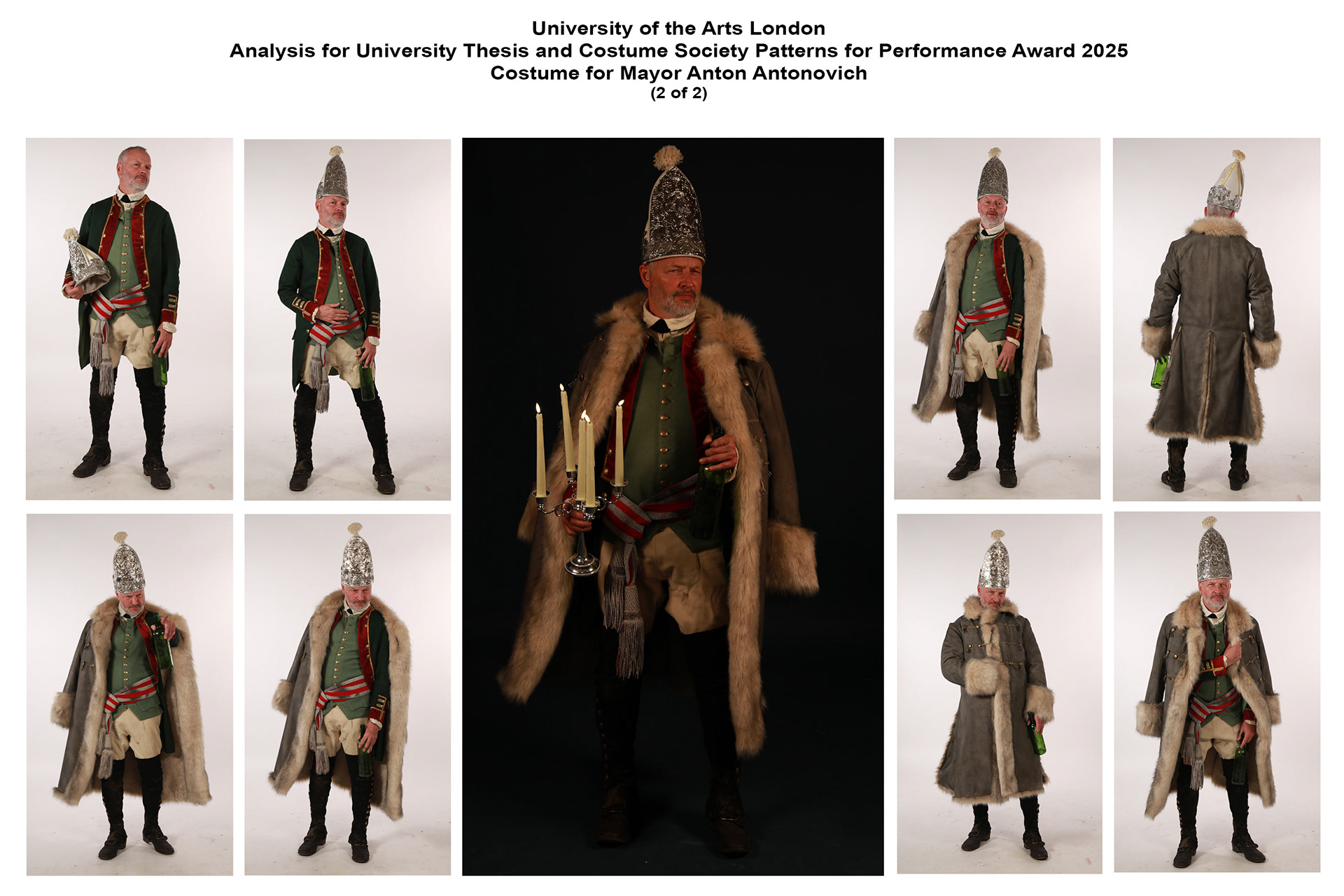
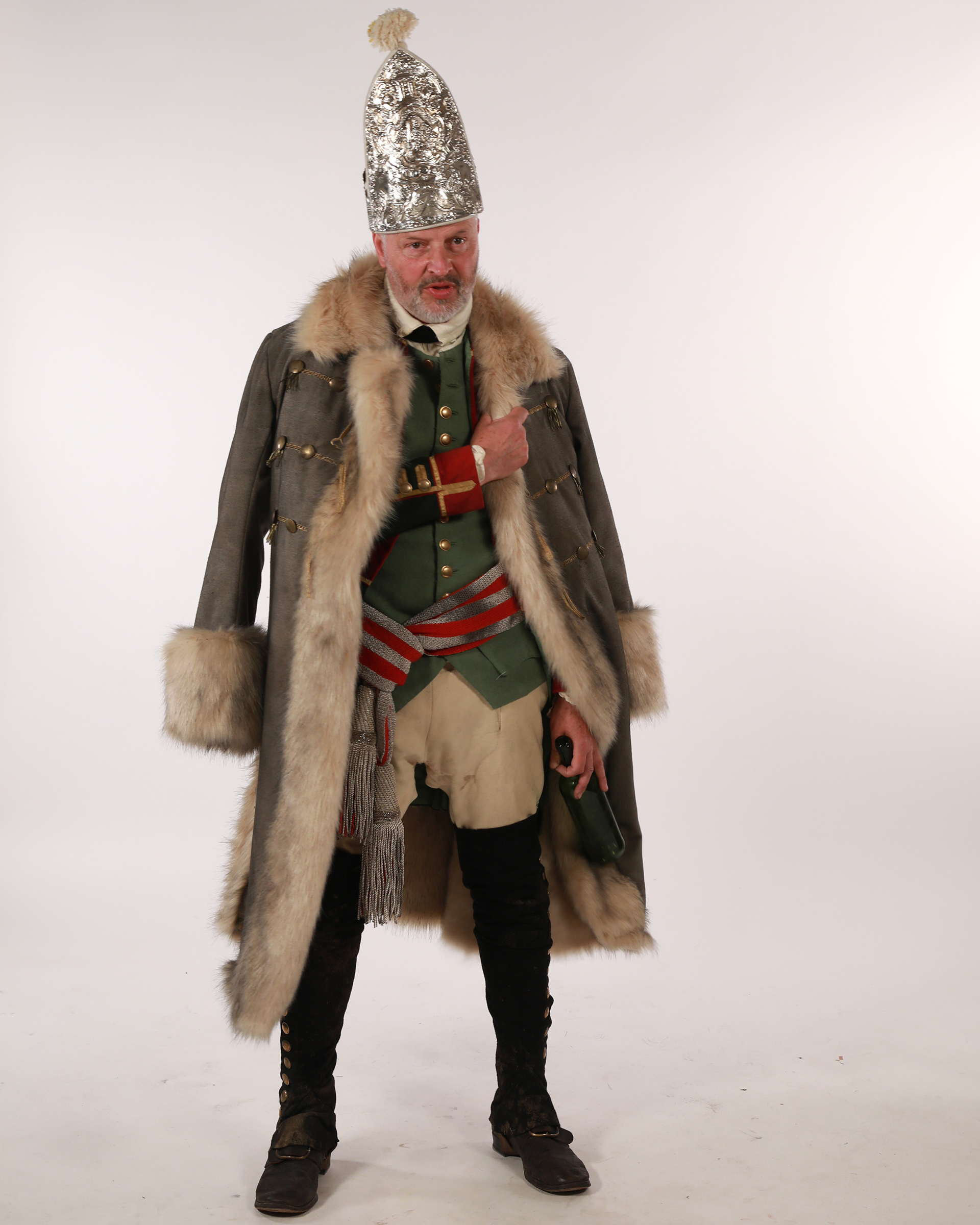
I decided to take part in the Patterns for Performance competition as part of my final year studying Costume Design for Stage and Screen at the University of the Arts London. It was a chance to put my lifelong love of history and costume making into practice and to create something that blended research, storytelling, and craft. I wanted to take on a project that was richly layered; something that explored how politics, culture, and history shape what we wear. For my entry, I chose to reinterpret Anton Antonovich Skvoznik-Dmukhanovsky, the pompous mayor in Nikolai Gogol’s satirical play The Government Inspector. Anton is vain, corrupt, and deeply insecure; qualities that still feel uncomfortably familiar today. I wanted to reimagine him in a way that went beyond the tidy, polished mayor we often see on stage and screen. I wanted my Anton to more closely mirror what I read: dishevelled, hungover, and carelessly dressed, his once-grand uniform stained and torn, a perfect visual metaphor for his moral decay.
To make my interpretation stand apart, I started by looking at how others had approached the play. I watched both the 1952 Soviet film Revizor and the 1949 Hollywood musical The Inspector General, each set in a vaguely Napoleonic era but taking very different stylistic approaches. That sparked a question for me: what if I shifted the story to a moment in Russian history where uniforms themselves were part of the satire?
That’s when I found the perfect period, 1797, just after the death of Catherine the Great and during the short, turbulent reign of Tsar Paul I. Paul’s obsession with Prussian-style military order extended into every detail of dress. Soldiers were forced to braid their hair with foul-smelling paste and wear stiff, tight uniforms that one English observer described as “so rigid they could not sit, and if they fell, they could not get up again” (Grey, 1970). These reforms, combined with harsh punishments for minor infractions, led to mass resignations from the Imperial Guard (McGrew, 1992). General Suvorov mocked the emperor, saying, “Sire, there is powder and powder; curls are not cannon, a pigtail is not a bayonet, and I’m not a Prussian but a pure-blooded Russian!” (McGlinn, 2021) These reforms were hated so deeply they eventually contributed to Paul’s assassination in 1801 (McGrew, 1992). It felt like the perfect historical mirror for Gogol’s satire, an age of vanity and control where appearance literally outweighed comfort or sense.
Around this time, I was working part-time on Apple TV’s Slow Horses, where the head of crowd costume Alex was kind enough to introduce me to her friend Sharon Long, who was the Emmy Award winning costume designer of The Great. Talking with her completely shaped my approach. She spoke passionately about the importance of grounding design in history while still serving the story. “Without a historical framework,” she told me, “a costume loses its meaning.” That idea became my mantra throughout the project. I wanted Anton’s uniform to be historically credible but also a reflection of his inner chaos and hypocrisy.
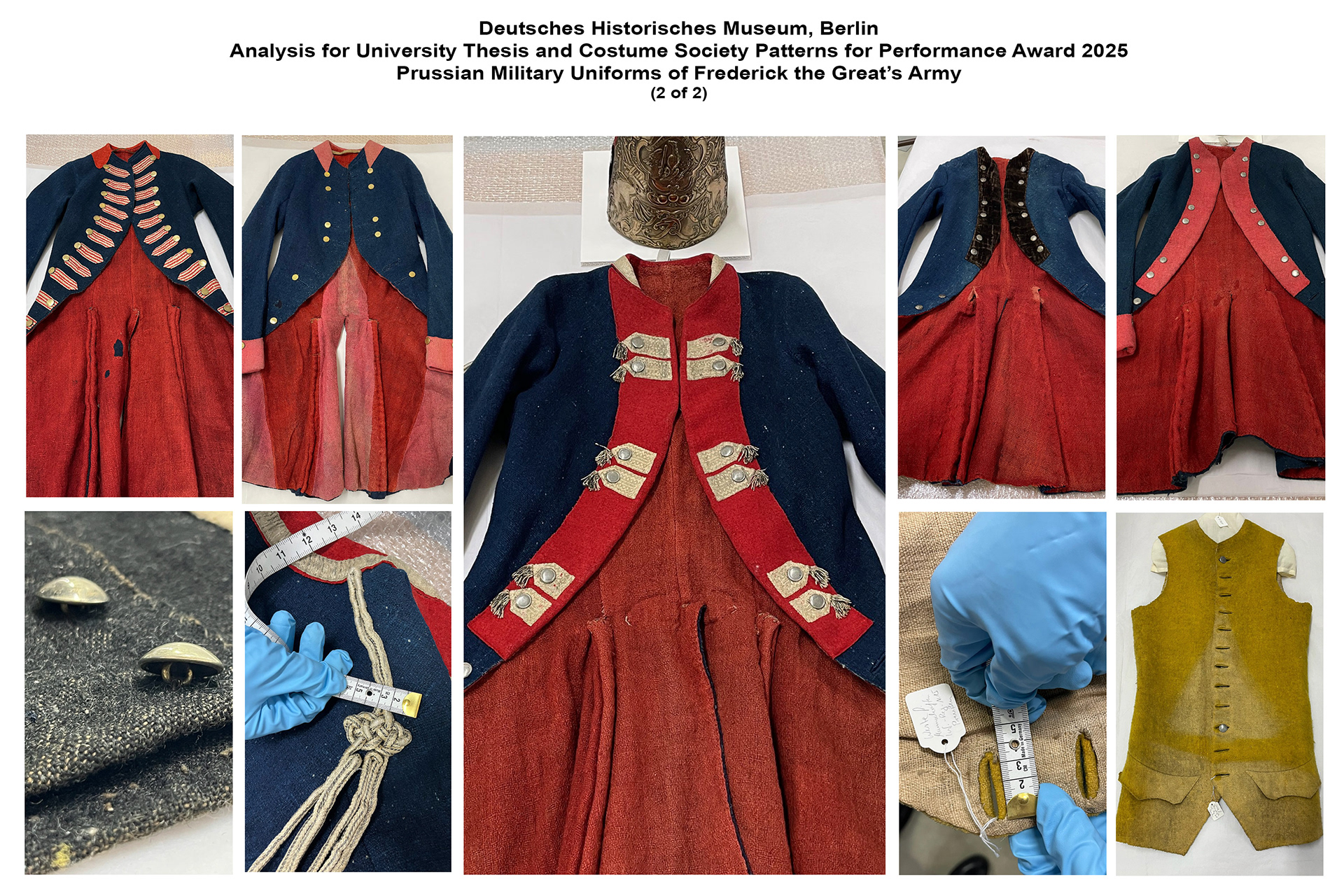
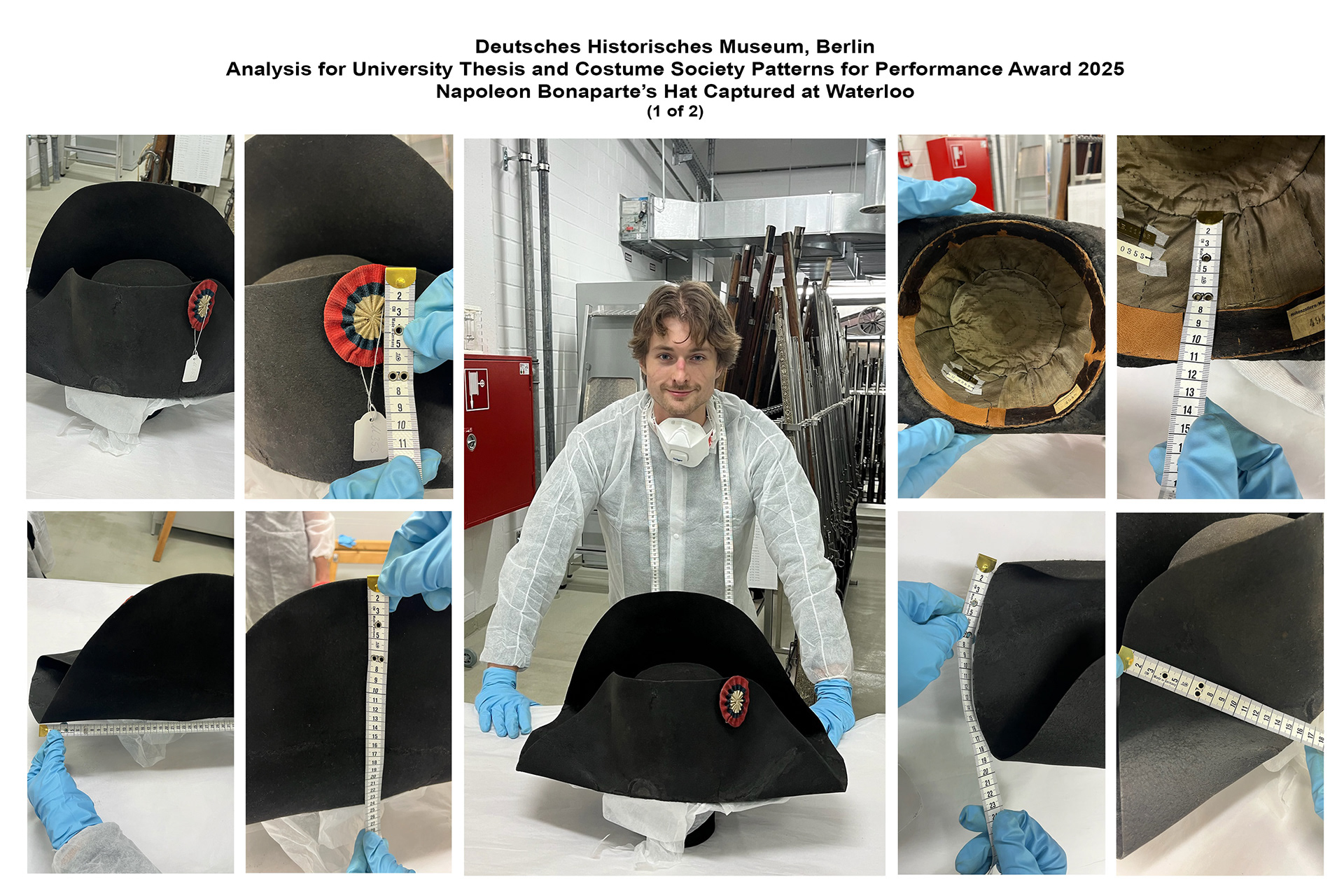
My research began with Norah Waugh’s The Cut of Men’s Clothes 1600–1900, which became my starting point for drafting the coat, waistcoat, breeches, shirt, and overcoat. I adapted each pattern to reflect both Prussian and Russian styles of the late eighteenth century. That said, the most transformative stage of my research came during a visit to the Deutsches Historisches Museum (DHM) in Berlin. Under the guidance of curator Thomas Weißbrich, I was able to handle and examine original Prussian Army uniforms from the time of Frederick the Great. Wearing protective gloves, I studied every detail, the tight tailoring, the decorative braids, and the fabric choices designed for discipline and display. What surprised me most was how imperfect these garments were. From the outside they were immaculate, but the hidden stitching was coarse, the linings were pieced together from scraps, and the pleats were held by long cords. These uniforms were façades, beautifully tailored where it showed, rushed and honestly not very practical. That discovery became the foundation of my design. It reminded me that historical accuracy doesn’t mean perfection, and that authenticity often lies in imperfection.
For Anton’s uniform, I wanted to capture that same contrast. The coat features non-functional red velvet facings and gold bullion braiding hand stitched directly down to the body of the coat. The waistcoat is cropped at the back and lined with cheap linen, its mint-green front finished with hand-stitched welted buttonholes. The breeches have tied knee bands and a deliberate tear in the inseam to suggest wear, while the shirt, cut directly from white linen, is heavily distressed. His faux fur-lined overcoat, inspired by the “Russia Coats” worn by Napoleon’s army, has exaggerated collars and cuffs that make him look as if he’s hiding behind his own vanity. Even the Grenadier cap and knee length gaiters were reconstructed using measurements from originals in the DHM collection.
Winning the Patterns for Performance Award was an incredible honour, but what I value most is the journey the project took me on. Researching, drafting, and building Anton’s uniform taught me that costume design is not just about reproducing history, it’s about interpreting it. Every tear, stain, and uneven stitch tells part of the story. For me, Anton’s uniform became more than clothing. It became a metaphor for his character: outwardly grand, inwardly broken, and entirely trapped by his own performance of power. For me that, in essence, is what costume
design does best, it reveals the truth that characters would rather keep hidden.
design does best, it reveals the truth that characters would rather keep hidden.